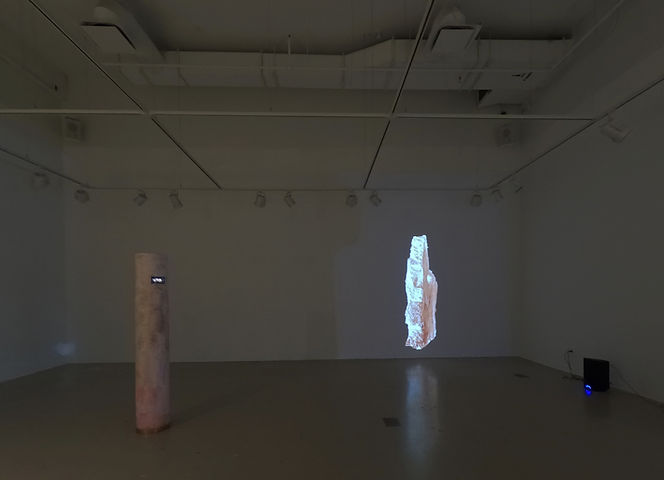
Assembly of Repair 2024
Installation: Moving image sculpture, Augmented reality, sound (2024)
Repair as the force-of-form that calls forth a tending not of a lost whole but of the gestural in its precise tentativeness. Repair as variation on existence. Repair as minor gesture. The archive as archive of time passed, as archive of time for the restaging of that past, orients us toward a certain notion of repair. It asks: how to return to liveliness that which has come to pass? How to give the force-of-form to that which is but the event’s afterthought? How to return to the trace of time’s passing the intensity of what could only really be felt in its own time? How to repair what has been left behind? How to repair to that time of wholeness? -Erin Manning
Assembly of Repair reflects on historical rupture and the intergenerational transmission of memory while engaging acts of looking and sensing across virtual and physical spaces, becoming a site where personal, political, and fictional elements converge. These relationships are reconstructed into multisensory, speculative forms that stretch across time, space, and architecture. Based on archival, geological and architectural records, the "minor gesture" that activates and carries the assembly is an archival fragment extracted from a French colonial film produced in 1950 by French filmmaker Jean-Claude Huisman, who was sent to document the Amazigh-Jewish community in Illigh, a village located in southern Morocco. His film follows the daily life of this community, which would be deported and displaced from Morocco three years after it was made. In this film, I discovered descendant relatives, including my aunt Zahra as a young girl, performing the daily task of pounding wheat with wooden mortars. Following the discovery of the film, I traveled to Morocco in 2023 to search for what remained in the village and its surviving traces. What persisted at the site are earthen ruins that stand as monumental architectural relics, inscriptions of a place once inhabited, now weathered into traces of memory shaped by wind and time, yet still resonating with the spectral presence of the community that thrived there nearly 75 years ago.
Through digital and electroacoustic processes, I extracted the sound of the pounding mortar and transformed its sonic fragment, sculpting its rhythmic sounds into a dynamic, immersive soundscape. This processed sound was then synthesized into visual rhythm, appearing as flashing pulses within the moving image sculpture. Visual recordings of the ruins were mapped, scanned, photographed, and reinterpreted as virtual 3D monuments. Within the augmented reality environment, these monuments rise and shift, shimmering with a spectral presence—as though surfacing from another layer of time. This spatial experience extends into a poetic environment that weaves together physical and virtual realities, where diasporic memory is not only seen and heard but sensed through gesture and movement. The sculpture performs as an intermediary figure—transmitter, receptor—transforming into a conduit. Constructed using encaustic techniques, the sculpture incorporates beeswax, various tree resins, ochre earth pigments, and copper; all materials that transform over time and originate from living sources. Its appearance oscillates between earth and flesh; its surface is carved, marked, and inscribed with typography, symbols and signs remediated from gathered archival materials. The inscriptions reveal themselves as viewers circle the sculpture, visible in both daylight and darkness. At eye level, a slit-sized monitor screens a looping visual and textual animation. Through its physical presence, the sculpture implicates the spectator's gaze. Viewers move back and forth between close, physical witnessing of surfaces and the virtual, augmented layer, confronting a mirrored tension between seeing and sensing through texture, opacity, transparency, and proximity.
The interactive augmented reality environment is accessible via mobile devices through the free Adobe Aero application. Users can activate the work, which responds to their movements and creates a haptic sound experience based on their distance and proximity to the sculpture, surrounding space, and virtual environment. The AR experience is solitary and requires a headset. Users sense and respond to the composition through intuitive, embodied gestures in physical space—creating a poetic space that blurs physical and virtual realities where diasporic memory is constructed and felt through sensory activation, participatory engagement, bodies, and architecture.
Curatorial text:
The aesthetic links between people and land are explored by interdisciplinary artist researcher Nava Messas-Waxman. In her 2024 installation, Assembly of Repair, she sutures together sampled colonial documentary film, augmented reality (AR), and a sculptural pillar resembling the biblical figure of Lot’s wife. Visitors are invited to use their personal smart devices to download and interact with the AR works that are inspired by the artist’s ancestral home, place them in the gallery and bring them “home” to re-enact diasporic uprootings and regroundings. Through the intermingling of virtual and physical, lived experience and official histories, Nava troubles geopolitical borders; her identity as a Moroccan Jew elides firm boundaries as seen in the assemblage of physical, digital, and virtual cultural artefacts that construct a living diasporic archive that evades dominant narrations. -Marissa Largo
Sound Mix: Eldar Baruch
Voice: Adi Gora
Exhibited at Tentacular Futures, Markham Campus Gallery, curated by Dr. Rebecca Caines & Dr. Marissa Largo


